German Companies Advance More Than €600 Million in Investment Projects in Latvia
Renewable energy, defence, autonomous mobility and space technology emerge as key areas of German-Latvian business cooperation
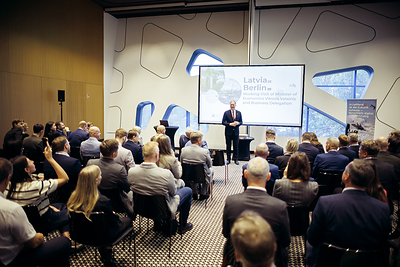
German companies are advancing investment and cooperation projects worth more than €600 million in planned investment in Latvia, following a business mission held in Berlin from September 14 to 17, 2026.
The projects span several strategic sectors, including renewable energy, defence, autonomous mobility and space technology, highlighting the growing economic links between Germany and Latvia. The Investment and Development Agency of Latvia (LIAA), which organised the trade mission, said the two most advanced projects alone account for more than €600 million in planned investment.
Renewable Energy Projects Move Forward
One of the key developments involves German renewable-energy company Notus Energy.
During the Berlin meetings, discussions focused on two renewable-energy projects planned in Latvia. The talks covered issues including grid connections, permitting and financing, indicating that the projects are moving into more detailed development stages.
Renewable energy is becoming an important area of Latvia’s efforts to attract international investment and expand its energy infrastructure. For German companies, Latvia offers opportunities to develop projects within the wider European energy market while strengthening cross-border cooperation in clean-energy technologies.
Defence Manufacturing Cooperation Expands
Another major project involves German defence company Dynamit Nobel Defence, which is advancing plans for a production facility in Latvia.
The company and Latvian authorities previously signed a memorandum with Latvia’s State Defence Corporation in February 2026. During the latest trade mission, discussions moved forward on the proposed production facility.
The development is part of broader cooperation between Latvian and German companies in defence and dual-use technologies. During the Berlin mission, Latvian companies also met representatives of major German defence-industry companies, including Rheinmetall, HENSOLDT, Rohde & Schwarz and Quantum Systems.
Autonomous Mobility Becomes Another Focus
The trade mission also included discussions with HOLON, a German company working on autonomous mobility.
Latvian representatives explored opportunities for cooperation in manufacturing, supply chains, autonomous-mobility testing and technology development.
Such cooperation could connect Latvian manufacturing and technology capabilities with German expertise in automotive and autonomous transportation systems. The discussions also reflect the broader push to develop new mobility technologies and associated industrial supply chains within Europe.
Space Technology Cooperation
Space technology was another area highlighted during the mission.
Berlin-based LiveEO, a space-technology company with a Latvian subsidiary that has operated for four years, was invited to expand its activities in Daugavpils, Latvia.
The company uses satellite-based data and technology for applications related to infrastructure and environmental monitoring, making its potential expansion relevant to Latvia’s growing technology ecosystem.
Data Centres and Digital Infrastructure
Latvia also presented opportunities in data-centre investment to German businesses during the mission.
The discussions come as demand for computing infrastructure continues to grow across Europe, driven by artificial intelligence, cloud services and data-intensive industries.
Latvian ICT companies also participated in the Big Bang AI Festival and other German-Baltic digital cooperation events, creating additional opportunities for technology partnerships between companies from the two countries.
Fintech and Life Sciences Add to Business Cooperation
The mission was broader than industrial investment.
Latvian fintech companies met with 20 institutional investors, family offices and financial-sector representatives in Germany. According to LIAA, eight Latvian-regulated investment platforms serve more than 800,000 foreign investors and have facilitated more than €13 billion in investments. German investors account for around 30% of demand on those platforms, according to the agency.
Life-sciences representatives also visited Berlin’s biotechnology and healthcare ecosystem, including organisations and institutions in Berlin-Buch and the German healthcare sector.
The delegation’s programme therefore covered multiple areas of the modern economy, from energy and manufacturing to fintech, healthcare, ICT and advanced technology.
Germany Remains a Major Economic Partner for Latvia
The latest investment discussions build on an already significant economic relationship.
LIAA reported that trade in goods and services between Latvia and Germany reached €5.5 billion in 2025, with Latvian exports accounting for €2.09 billion. Germany is also Latvia’s largest export market outside the Baltic states, according to the Latvian agency.
LIAA separately reported that German foreign direct investment accumulated in Latvia amounted to €1.63 billion, while more than 1,000 companies with German capital operate in the country.
Trade has continued to expand in 2026. According to LIAA, Latvian exports of goods to Germany increased by 11% in the first half of 2026, while total Latvian exports grew by 6% during the same period.
New Export and Investment Support Agreement
The trade mission also resulted in an institutional agreement.
LIAA, the German Chamber of Commerce and Industry (DIHK) and the German-Baltic Chamber of Commerce (AHK) signed a memorandum aimed at giving Latvian exporters access to the German Chambers Abroad network, which operates at 150 locations across more than 90 countries.
AHK will also establish a dedicated contact point for supporting Latvian exporters.
The initiative could make it easier for Latvian companies to identify German customers, partners and investment opportunities while strengthening Germany’s role as a gateway for Latvian businesses seeking international expansion.
From Investment Discussions to Implementation
The latest announcement does not mean that all of the €600 million has already been invested.
LIAA said some projects are moving toward implementation, while others still need to progress through stages such as testing, supplier qualification, permitting, financing or contractual agreements. The agency said it would continue working with companies and investors as the projects develop.
The developments nevertheless demonstrate the breadth of German-Latvian economic cooperation, with projects now being explored across renewable energy, defence manufacturing, autonomous mobility, space technology, data infrastructure, fintech and life sciences.
As European companies increasingly look to strengthen regional supply chains and develop strategic technologies within Europe, the emerging projects could create additional opportunities for industrial cooperation between Germany and Latvia.